Live Blackjack Online Casinos in the UK: 2026 Guide
 Available in GB
Live blackjack pairs a dealer handling physical cards with an online interface for placing wagers and making selections during each hand.
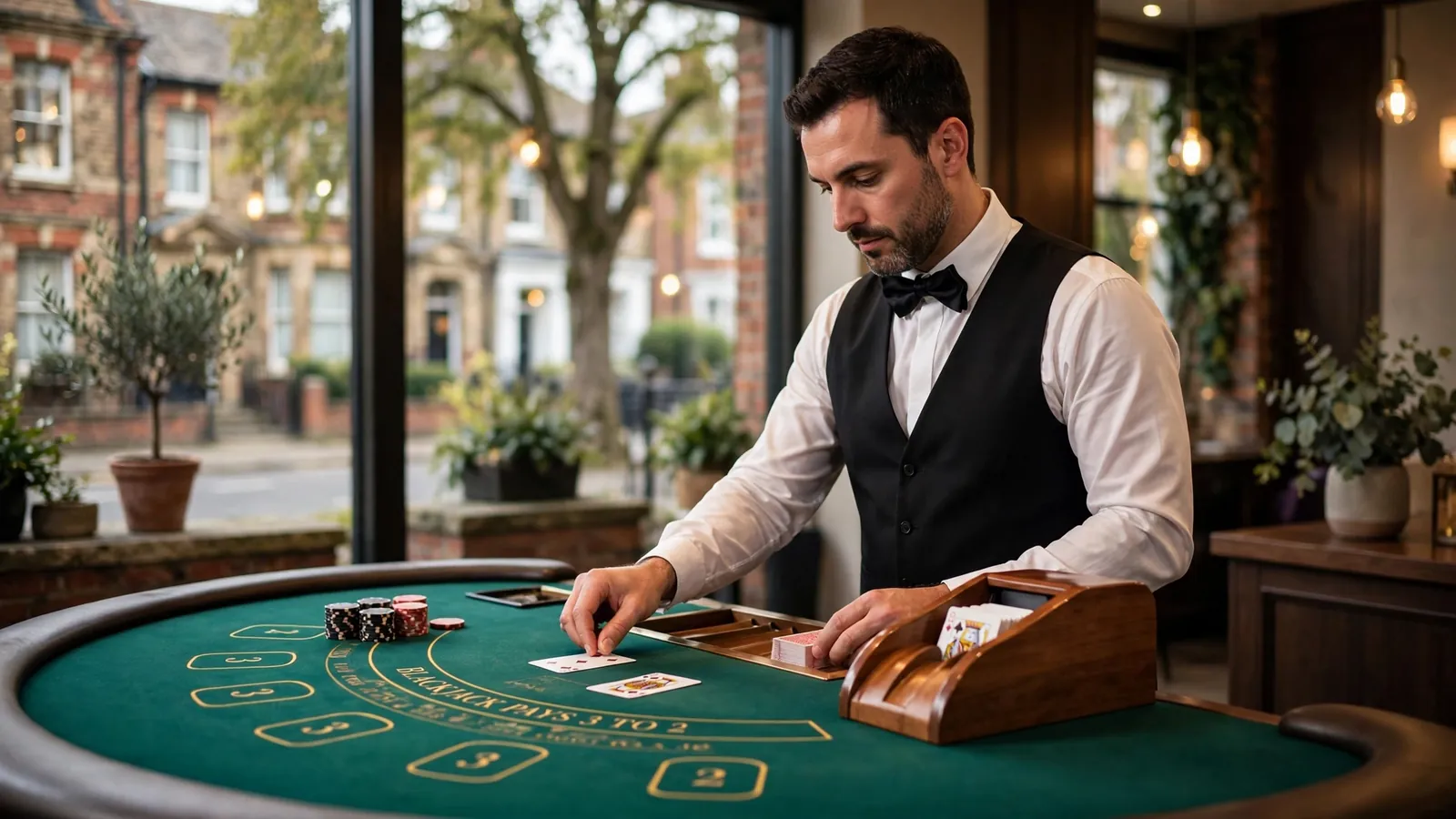
Table of Contents
- How a Live Blackjack Table Works
- What Makes a Blackjack Casino Suitable for UK Play
- How to Compare Blackjack Casinos Without a ‘Best’ List
- How Blackjack Decisions Shape a Hand
- Live Blackjack and the Other Games Around the Table
- Starting a Blackjack Session Online
- Blackjack Strategy—and the Slot Limits That Do Not Apply
- Checking a Casino’s 2026 Status Before Playing
- Bonus and Bitcoin Claims: Read the Conditions, Not the Label
- The Blackjack Rules That Govern a Live Hand
How a Live Blackjack Table Works
A live-dealer blackjack game combines a streamed table with the controls of an online casino. The dealer handles physical cards in a studio or casino setting, while cameras transmit the table to a screen. Players join remotely, place wagers through the game interface and make their selections there. The stream supplies the visible table action; the software handles the connection between that action and each player’s seat.
That is the main difference from an automated blackjack game. In an automated version, software generates and displays the cards without a human dealer appearing on screen. A live table shows a dealer handling the cards and the game unfolding in real time. The interface still matters: it records wagers and player choices, displays the hand and communicates what is happening at the table. It is not a video call, and the dealer is not taking instructions verbally.
The distinction is easy to blur in marketing. “Live” describes the presentation and dealing format, not a promise that the game is more favourable or that every part of the experience is free from software. The casino platform still manages the session, and the stream has to be synchronised with the game interface. I pay attention to that division because it explains what the camera can show and what the software must communicate.
A typical session begins with a view of the table and a betting area on screen. Once a round is open, the interface indicates when wagers can be placed and when betting has closed. The dealer then deals the cards, with the stream showing the action as it happens. Buttons or prompts appear when a decision is required. A player responds through the interface, not by speaking to the dealer; the dealer sees the relevant table information and continues the hand.
Live Baccarat Online Casinos in the UK: Licence Checks
The display is doing more than decorating the broadcast. It tells the player which seat or hand is active, shows the cards and presents the available controls at the appropriate point. A stable connection makes that sequence easier to follow. If the video lags, the interface may still show a prompt, but the experience becomes harder to read. The stream and the controls are separate parts of one product.
Some live tables offer chat, allowing brief messages to the dealer or other participants. That can make the table feel social, but it does not change the mechanics of the hand. The dealer follows the game’s procedures; the chat is an added layer around them. In practice, the useful question is whether the stream, prompts and table view remain clear enough to understand what is taking place.
A live dealer blackjack casino can suit someone who prefers seeing cards handled at a table rather than watching an animated interface. An automated game may be more direct and self-contained. Neither format changes blackjack into a different game, and a live stream does not make outcomes predictable. The visible dealing is part of the appeal, not evidence of an advantage.
The format has been part of the UK casino landscape for years. Grosvenor introduced live casino games in 2013, with Blackjack among a wider selection that also included Texas Hold’em and Roulette. That history helps explain why live blackjack is now familiar in online casino lobbies, though the look and layout of individual tables can differ.
For real-money play, the table is therefore best understood as two things working together: a human-led card game on camera and an online interface that manages participation. The first gives the game its visible pace; the second makes remote play possible. A stream, not a shortcut.
What Makes a Blackjack Casino Suitable for UK Play
For a blackjack casino to be suitable for play in Great Britain, the starting point is not the table design or the welcome message. It is whether the business is authorised to offer remote gambling to people in the market. The UK Gambling Commission regulates gambling activity in the UK, including online casinos, and is the sole regulator for commercial gambling in Great Britain.
The UK Gambling Commission is the sole regulator for commercial gambling in Great Britain, and a business must be authorised by them to offer remote gambling to people in this market.
That responsibility follows the customer, not the operator’s server room. A remote casino offering gambling to consumers in Great Britain falls under the Commission’s remit even when its key equipment is located elsewhere. A business cannot avoid the requirement by being based overseas or by hosting its games abroad. The Commission issues operating licences to businesses; it also issues personal licences to individuals working in relevant roles. Those are different permissions, with different purposes.
I have always treated the licence as the foundation, not as a quality award. It establishes that the operator is within the regulatory system. It does not mean every term will suit every customer, or that every session will go smoothly. The practical checks still matter.
What the licence means in practice
A licensed operator is accountable to the regulator for the gambling it offers. That framework matters because the casino is not simply a website presenting games: it is a business handling deposits, wagers, account records and customer disputes. If the operator’s name, trading identity or website address does not line up with the information on the Gambling Commission’s public register, that discrepancy should be resolved before money is added.
The register check is a basic control, not a substitute for reading the casino’s own terms. A familiar brand name alone does not establish that a particular site is operated by the licensed business. Nor does a polished page establish regulatory status. The licence number should be checked against the public register before depositing.
Keno Casinos in the UK: How to Compare Online
There is a useful distinction between a licence held by a company and a personal licence held by an individual. The business licence is the relevant starting point for the casino itself. Personal licences apply to people in specified operating roles; they are not a separate endorsement of each blackjack table. Keeping that distinction clear prevents regulatory language from being used as a vague badge of trust.
Account safeguards before funding
The account process should include age verification before a customer is allowed to deposit. That is a gate, not a courtesy prompt. If an operator appears to permit funding before checking age, the process is not behaving as it should.
New customers must also be prompted to set a financial limit before making their first deposit, with account-level limit controls made accessible. These controls are part of the account infrastructure, not an optional feature tucked away as a promotional extra. I look at whether the controls are findable and usable, rather than whether the casino advertises them in large type.
Payment methods provide another straightforward test. UK-licensed casinos cannot accept credit cards for gambling, including credit-card funds routed through a money service business. A wallet cannot be used for gambling where it allows credit-card funds to be used for that purpose. A payment logo on a page is not enough to establish that every route through that method is permitted; the relevant question is how the funds are sourced and processed.
This is where operational details matter more than reassuring copy. “Secure” describes a claim. The actual funding options and account controls show how the operator has implemented its obligations.
Payment Restrictions
UK-licensed casinos cannot accept credit cards for gambling, including funds routed through a money service business.
Complaints and safer gambling arrangements
A UK Gambling Commission licensee must provide an internal complaints process and access to an approved Alternative Dispute Resolution service. The internal route is the first place a complaint is handled; the ADR route provides an external means of resolving eligible disputes if the operator’s process does not settle the issue. These are important protections, though they do not mean every disagreement will be decided in a customer’s favour.
Licensed casinos must also provide responsible gambling tools, including self-exclusion. The tool needs to function at account level, rather than appear only as a line in a policy page. Operators are also required to contribute to the Research, Education and Treatment levy. That contribution is part of the regulated system, not a donation chosen by a player.
None of these measures makes gambling risk-free. A licence does not change the financial uncertainty of blackjack, and account controls cannot decide whether a session is affordable. The sensible boundary is plain: only gamble with money that can be afforded to lose.
A regulated casino has duties behind the interface. The licence, age check, limit prompt, payment restrictions, complaints route and self-exclusion provision are the working parts of that arrangement. Advertising tends to foreground the table. The protections sit around it.
How to Compare Blackjack Casinos Without a ‘Best’ List
A “best” label often compresses several different judgements into one sales claim. One player may care about table choice; another may value clear terms or effective account controls. I find a comparison more useful when it shows what was checked and leaves the trade-offs visible. The same operator can look strong on one point and weak on another.
Progressive Slots Online in the UK: How Jackpots Work
Start with the operator, not the table
Before comparing blackjack options, I check the operator behind the website. The Gambling Commission requires remote operators serving consumers in Great Britain to hold the relevant licence. A familiar brand, polished site or live table supplied by a recognised studio is not a substitute for checking the operator’s licence.
The useful detail is the licence entry, not a logo in a footer. I match the operator’s legal name and the website domain against the Commission’s public register, then verify the licence number before any deposit. A mismatch between the company named in the register and the business presented on the site needs resolving before the casino can be treated as a serious candidate.
This check is more than box-ticking. A game provider supplies software or a live product; it does not, by itself, establish that the casino operator is licensed to offer gambling to Great Britain customers. Different roles. Different checks.
Compare what each table actually discloses
Once the operator has passed that initial check, I look at the table information. A lobby tile may give a game name and an attractive image, but that does not tell much about the conditions attached to play. The table’s own information should make its rules and relevant limits clear before a wager is placed.
I compare whether the casino identifies the game version, explains the rules that affect a hand and makes any table limits easy to find. If a table offers optional side bets or other features, those should be distinguishable from the main game rather than hidden in promotional copy. Where information is hard to locate, that is a comparison result in itself: it makes informed selection harder.
Do
- Check the operator’s legal name and domain against the public register
- Verify the licence number before depositing
- Compare clear table rules and limits
Don’t
- Rely on a familiar brand name or polished website
- Treat a game provider’s status as the operator’s licence
- Use a “best” label as a substitute for individual checks
The number of tables is not a quality score on its own. A broad lobby can still leave the important details unclear, while a smaller selection may be easier to assess. I note what is available, but give more weight to whether each option is described plainly and consistently.
Read terms as operating instructions
Terms are often treated as legal material to skim past. In practice, they show how the operator handles the points that matter when an account is used. I check whether promotional wording is separated from the underlying game conditions, whether restrictions are explained in plain language and whether the casino states how disputes or account issues are handled.
A phrase such as “flexible play” sounds generous; the useful question is what it permits and what conditions still apply. If a term could affect access to a table, a wager or a withdrawal, I look for the relevant explanation rather than relying on the headline. Unclear wording is not proof of misconduct, but it is a reason to avoid treating an offer as a settled benefit.
I also distinguish game rules from operator terms. The rules govern the hand; the terms govern the relationship with the casino. Mixing them up can make a table appear more or less attractive for reasons that have nothing to do with blackjack itself.
Check controls, not just presentation
A comparison should include the tools attached to the account. I look for accessible ways to set and change financial limits, review activity, take a break or self-exclude. A control that exists somewhere in a help page is less useful than one that can be found and understood from the account area. The wording should explain what the control does, not merely display a reassuring icon.
I also check whether the casino explains its complaints process and provides access to an approved Alternative Dispute Resolution service. This is not a prediction that a dispute will happen. It is a test of whether the operator has made the route visible before something goes wrong.
Responsible gambling language can become decorative. The practical comparison is whether controls are clearly presented and usable, not how many times a site says “play responsibly”. I keep one rule outside the scoring altogether: only gamble what can be afforded to lose.
Live Dream Catcher Casino UK: What to Check
Make the comparison auditable
For each casino under consideration, I record the operator and licence details, the table information available, the clarity of terms and the visibility of account controls. A simple note beside each category is more useful than an unsupported overall winner. It also makes a change in the site easier to spot later.
The result may be that one casino has clearer table disclosures while another presents its account tools more plainly. That is a real distinction, not a ranking failure. The point is to identify what suits the intended way of playing without letting a “best” badge do the thinking. No universal winner.
How Blackjack Decisions Shape a Hand
A blackjack hand is shaped by a series of choices, not by one move that can force a favourable result. The player sees their cards and the dealer’s exposed card, then decides whether to take another card, keep the hand as it stands, or use an option such as doubling or splitting when the table rules allow it. Each choice changes the position of the hand; none controls what card comes next.
The first decision is whether the current total is worth holding. Taking a card may improve a weak hand, but it may also push the total beyond the limit and end the hand immediately. Standing avoids that risk, while leaving the player to rely on the existing total against the dealer’s eventual hand. There is no choice that removes uncertainty. The practical question is which risk is more acceptable in the situation.
The dealer’s exposed card provides context, not a prediction. A card that looks strong may suggest the dealer is well placed, but the hidden card and later draws are still unknown. I have seen players treat the exposed card as if it settled the outcome; it does not. It is one piece of information to weigh alongside the player’s own hand and the rules in force at that table.
Doubling changes the scale of a decision: the player commits to a larger wager in exchange for a restricted continuation of the hand, subject to the table’s conditions. Splitting separates a qualifying pair into separate hands, which then develop independently. Both options can make sense in particular situations, but they are not automatic upgrades. A split creates more exposure; doubling places more at stake before the result is known. The details depend on the casino’s rules, so the table information matters.
Fast Payout Online Casinos in the UK: What Claims Mean
This is where “strategy” can be a misleading label. It may mean applying a consistent decision method rather than choosing by instinct, but it does not mean having a way to make the next card favourable. A disciplined choice can still lose, and a careless choice can sometimes win. Looking only at the result hides the quality of the decision: a sound decision is judged by the information available when it was made, not by whether that individual hand paid out.
For online casino blackjack, the same distinction applies whether the cards are dealt at a live table or by a game interface. The format changes how the hand is presented; it does not turn uncertain outcomes into certainties. Table rules also affect which options are available and how they work, so assumptions carried over from another game can lead to poor decisions.
I would separate three things when reviewing a hand: the information visible at the decision point, the options permitted by the table, and the result that followed. Mixing them together encourages hindsight—after a loss, every alternative can look obvious. It rarely was.
No system removes variance, and a run of wins is not proof that a method guarantees future results. Blackjack remains gambling, even when decisions are deliberate. Only wager what can be afforded to lose.
Live Blackjack and the Other Games Around the Table
A live casino lobby is not simply a page of blackjack tables. It is a wider catalogue in which a blackjack game may sit alongside other card games and casino formats. That context matters: the lobby is designed to present several kinds of play, not to make every option a variation of blackjack.
Grosvenor provides a long-running example. The operator first introduced its live casino games in 2013, with a selection that included Blackjack, Texas Hold’em and Roulette. That mix shows how a live offering can bring card games and other casino games together under one heading. Blackjack remains a distinct choice within the range; its presence does not mean the surrounding games follow the same rules or suit the same preferences.
In practice, a lobby’s layout can shape what is noticed. A player looking for blackjack may see it grouped with other live tables, or have to move between categories before finding the relevant game. The labels and order are part of the product: they direct attention, while the range itself tells something about how broadly the operator has built its live offering. Neither is proof that one game is better than another.
Classic Slots Online UK: Games, Rules and Play
I have found it useful to separate the name of a game from the way it is presented. “Live casino” describes a category, not a single experience. Within it, blackjack is one option among formats with different rules and rhythms. Texas Hold’em is also a card game, but it is not another blackjack table; roulette is a different casino game altogether. A shared lobby does not make them interchangeable.
The same distinction applies to the phrase “blackjack games”. It can refer to the available blackjack choices within a casino, rather than to the whole live catalogue. A lobby with several categories may make that distinction clear, but the category names and navigation still deserve a careful look. The actual selection can vary by operator, so a general description of live casinos should not be mistaken for a promise about a particular catalogue.
That wider view can also prevent a common misunderstanding: an operator may promote a broad live range, while a player’s interest is limited to one game. The breadth of the catalogue is a feature of the lobby, not a reason to move between games or increase spending. Blackjack remains one choice among many.
The commercial logic is straightforward. A broader catalogue gives the lobby more ways to hold attention; it does not change the nature of any individual game. I keep those two things separate. The menu is not the hand.
Any casino session carries financial risk. Only gamble what can be afforded to lose.
Our top casino picks for the UK
- DieselwinBonus: Welcome Pack 250% up to £4000 + 200 FS · Payout speed: 1-3 business days
- SpinFormulaBonus: 550% Up To £15,000 + 550 FS · Payout speed: 1-3 business days
- ChanzeBonus: Slots Welcome Bonus #1 200% up to €500 · Payout speed: 1-3 business days
- WinBeastBonus: €5000 + 500 FS + €650 Freebet · Payout speed: 1-3 business days
- EvoSpinBonus: 125% up to €2500 + 125 Free Spins · Payout speed: 1-3 business days
- x3betBonus: Welcome Pack 100% Up to £1.000 + 200 Free Spins · Payout speed: 1-3 business days
Starting a Blackjack Session Online
An online blackjack session begins with account setup, not at the table. Registration details must match the person opening the account, and the operator must verify age before allowing a deposit. In Great Britain, gambling is for adults aged eighteen or over. The check is a condition of access, not a formality that can be postponed until after play.
The next step is the account’s financial-limit prompt. Remote operators must ask new customers to set a limit before the first deposit and make account-level limit controls accessible. I treat that prompt as part of the session setup: it is where a planned entertainment spend can be separated from money needed for bills or other commitments. A limit is useful only if it reflects what can genuinely be lost without consequence.
Starting a Session
- Verify that registration details match your identity
- Complete age verification (must be 18+)
- Set a financial limit before the first deposit
- Confirm the payment method does not use credit cards
Before funding an account, the payment method also matters. UK-licensed casinos cannot accept credit cards for gambling, including credit-card funds routed through a money service business. A digital wallet is not a workaround if it allows credit-card funds to be used for gambling. Payment labels can obscure the source of money, so the funding route should be clear before it is selected.
Once the account is ready, the lobby may offer live blackjack, automated games, or both. A free-play mode, where available, can allow a look at the interface without staking money; its presence and conditions depend on the operator. It should not be confused with a funded session, where wagers are real and results affect the account balance. “Free” is a label, not a promise that every feature or table is available without conditions.
Account controls remain relevant after the first visit. A financial limit can help keep sessions within a chosen boundary, while self-exclusion is an option for someone who needs to block their own access to gambling. UK-licensed casinos must provide responsible-gambling tools, including self-exclusion. If gambling stops feeling manageable, support is available through GamCare, BeGambleAware and Gamblers Anonymous.
I keep the basic rule plain: only gamble what can be afforded to lose. If the account setup feels rushed, or the limit prompt is treated as something to click through, the session can wait. There is no need to fund an account before those decisions are settled.
Fastest Payout Online Casinos in the UK: What Counts
Blackjack Strategy—and the Slot Limits That Do Not Apply
A blackjack strategy is a decision framework, not a way to remove chance from the game. I treat it as a means of making choices consistently rather than reacting to a run of wins or losses. A chart or written plan can help keep decisions deliberate, but it cannot promise a return: the cards dealt still shape the outcome.
That distinction matters at a live table, where a steady pace and other players’ activity can make a hand feel more urgent than it is. A useful approach is to decide in advance how much money is available for play, keep to that amount and stop when the session no longer feels controlled. I have seen how quickly “one more hand” becomes a response to frustration rather than a considered choice. No system fixes that.
Strategy also depends on the game’s stated rules and options. Tables can differ, so advice written for one format may not fit another. Before relying on a chart, its assumptions need to match the table being played. In practice, a simple, understood plan is more useful than a complicated system that is difficult to follow under pressure. Keep the decisions clear.
The limits sometimes mentioned alongside online casino games need a separate explanation. A specialist review reports that Great Britain’s online slot stake cap is £5 for an adult aged 25 or older, while the cap is £2 for someone aged 18 to 24. The same review says those slot limits do not cover blackjack or roulette. These are limits for slot play, not a ceiling on a blackjack wager.
Attention Slot stake caps (such as the £5 limit for adults 25+ or £2 for those 18-24) do not cover blackjack or roulette.
That boundary is easy to blur in broad casino promotions, which may discuss several games together. But blackjack is not an online slot, and a slot-specific stake rule should not be presented as a blackjack rule. The distinction does not make blackjack risk-free: wagers can still be lost, and session controls remain relevant.
I prefer strategy that serves a modest purpose: make choices more deliberate, keep spending within an affordable amount, and avoid treating previous results as evidence that the next hand is due to go a certain way. The safest assumption is that no strategy guarantees a win. Only gamble what can be afforded to lose.
Checking a Casino’s 2026 Status Before Playing
A live blackjack page can look current while the legal position behind its brand is unclear. For a UK check in 2026, the useful question is not whether a casino advertises blackjack, but whether the business responsible for offering it to Great Britain customers appears on the Gambling Commission’s public register.
A specialist casino review reports that the register, dated 26 September 2026, did not identify a LuckyPays entry under that brand or the stated domain, including luckypays.io. That is a dated register result, not proof about every business relationship or a claim that the position can never change. Names and domains can differ from the legal company name, so an apparent absence calls for care rather than guesswork.
I treat the register as the point at which marketing language meets an accountable operator. A polished site, a live table and familiar game names do not establish that the business holds the required British licence. Nor does a logo or a claim of “UK-friendly” play answer the licensing question. The register check needs to connect the casino’s trading identity to the licensed business behind it.
Before depositing, verify the licence number on the UK Gambling Commission’s public register and confirm that the registered operator corresponds to the casino being used. If the brand or domain does not appear, or the relationship cannot be established from the register, do not treat the uncertainty as a minor paperwork issue. Pause before funding an account.
The date matters. A register entry is evidence of what the public record showed at that point, not a permanent status certificate. For a search framed around live blackjack in 2026, the recorded result is specific: the review’s dated check found no LuckyPays listing under the brand or stated domain. It should not be stretched into a broader finding about unrelated casinos.
Progressive Jackpot Slots: How the Jackpots Work
Licensing is a practical safeguard, not a prediction about whether a hand will go well. I would not let a welcome message or an attractive table override an unresolved register result. And the basic financial rule remains: gamble only what can be afforded to lose.
Bonus and Bitcoin Claims: Read the Conditions, Not the Label
A “blackjack bonus” is a promotional label, not a description of what can be withdrawn. I read the offer terms as a set of conditions: who qualifies, which games count, whether blackjack is included, and what must happen before bonus funds or related winnings can be withdrawn. A headline may foreground a bonus while placing the game restrictions elsewhere. The operative wording matters more.
The same applies to a no-deposit offer. The phrase does not establish that an offer is currently available, that it can be used on blackjack, or that any resulting balance is immediately withdrawable. The terms may distinguish between cash and bonus funds, limit eligible games, or require an account condition to be met. If those details are unclear, the label cannot fill the gap.
I have found it useful to separate three things: the amount credited, the games permitted, and the conditions attached to withdrawal. A blackjack casino bonus offer may refer to funds for wagering, a reward tied to an eligible activity, or something narrower. Those are not interchangeable. “No deposit” describes one feature of an offer; it says nothing by itself about the rest.
Payment claims need the same plain reading. A site mentioning Bitcoin does not, on its own, establish that Bitcoin deposits or withdrawals are available to a UK customer. The cashier and the applicable payment terms would need to say what is accepted and how the transaction is handled. Do not treat a logo or promotional line as a confirmed payment route.
For gambling operators serving Great Britain, credit cards cannot be used to fund gambling, including through a wallet that permits credit-card funds to be used for gambling. That restriction is about the funding method, not a promise that another payment option will be offered. Read the payment conditions separately from the bonus conditions.
Promotional wording is designed to attract attention; the detailed terms define its reach. I would not count a bonus as usable until its eligibility, blackjack status and withdrawal conditions are clear. And any wagering should be limited to money that can be afforded to lose. No label changes that.
The Blackjack Rules That Govern a Live Hand
Blackjack rules define what can happen from the deal to settlement; they do not tell a player which decision will win. I treat those as separate things. The procedure is set by the table, while strategy is a way of choosing between the actions that procedure allows.
A hand begins with cards dealt to the player and the dealer. The aim is to finish with a hand closer to twenty-one than the dealer’s, without going over. Number cards count at face value; picture cards count as ten, and an ace can count as one or eleven. A natural blackjack is an ace with a ten-value card in the opening hand. If a hand exceeds twenty-one, it busts and loses.
The available actions depend on the table rules and the hand. A player may be able to hit for another card or stand with the current total. Some tables also permit doubling, splitting a pair, or surrendering. Those options have conditions: splitting creates separate hands, while doubling changes the wager and commits the player to the table’s specified next step. The dealer’s required actions are fixed by the table rules, including whether the dealer must draw or stand on particular totals. Check those rules before play; labels and side bets do not replace them.
A winning decision is not the same as a guaranteed result. I have seen people confuse a familiar move with a rule. It is not. The rules settle the hand; they do not remove chance.
The account has its own rules. In Great Britain, remote gambling operators serving customers must hold the relevant Gambling Commission licence. The public register is the place to verify the licence before depositing. Licensed operators must provide an internal complaints process and access to an approved Alternative Dispute Resolution service; they must also offer self-exclusion. These safeguards sit beside the game, not inside its rules.
Online gambling is for adults aged eighteen and over. Age must be verified before an operator allows a deposit. I keep the financial side separate from the cards: gamble only what can be afforded to lose.
Are online casino games licensed and regulated?
Remote operators offering gambling to consumers in Great Britain must hold the relevant UK Gambling Commission licence. The Commission regulates gambling activity, including online casinos, regardless of where the operator’s key equipment is located.
What are the online slot stake limits in Great Britain?
The maximum stake per game cycle is £5 for adults aged 25 and over and £2 for adults aged 18 to 24. These limits apply to slots, not roulette or blackjack.
Is LuckyPays licensed by the UK Gambling Commission?
The Gambling Commission’s public register dated 26 September 2026 does not show an entry for LuckyPays or its stated domain, luckypays.io. Remote operators serving consumers in Great Britain are required to hold the relevant licence.
What licensing and regulations apply to online casinos in the UK?
The UK Gambling Commission regulates gambling activity, including online casinos, and is the sole regulator for commercial gambling in Great Britain. Remote operators serving consumers there need the relevant operating licence, regardless of where their key equipment is located; personal licences apply to individuals in specified roles.
Prepared by the Grovers Casino editorial staff.