Fruit Machine Slots UK: From Pubs to Online Reels
 Available in GB
Online fruit games retain familiar symbols, but digital outcomes, bonus terms and RTP ranges shape a different kind of session.
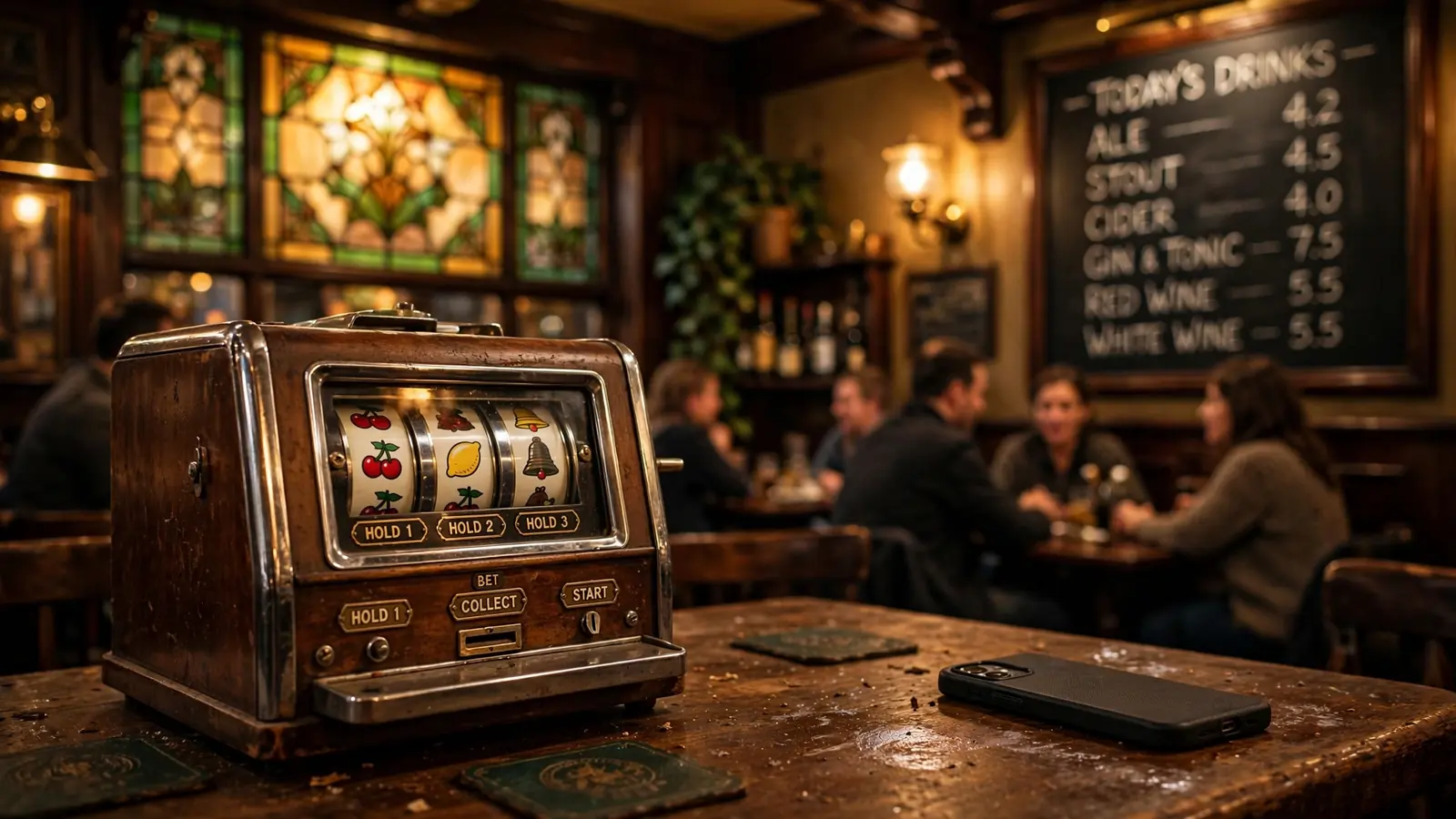
Table of Contents
- From Pub Fruit Machines to Online Reels
- What a UK Casino Must Provide Before Real-Money Play
- Real-Money Play: Identity Checks and Stake Caps
- Fruit-Themed Slots, from Familiar Reels to Megaways
- Rainbow Riches and the Fruit-Machine Casino Lineage
- Online Features That Change the Playing Session
- Classic Fruit Machines: Holds, Nudges and Simple Reels
- Fruit Slot Demos: What the Verified Facts Do—and Don’t—Show
- Bonus Terms, Free Spins and the Cost of Wagering
- RTP Is a Range, Not a Payout Promise
From Pub Fruit Machines to Online Reels
The familiar fruit machine began as a physical cabinet: reels turned, symbols stopped in view, and a result was judged against the machine’s displayed winning combinations. Its online descendants keep that recognisable visual language, but the cabinet is no longer doing the work. A digital game draws its results through software, with a random number generator producing independent outcomes. The screen may resemble a pub machine; the mechanism behind it is different.
That distinction matters when comparing a pub fruity with an online game. On a physical machine, the player sees reels move inside a cabinet. Online, those reels are an animated representation of a digital result. The spin is not a physical set of wheels slowing to a stop, and the symbols shown are not evidence that a previous result has made a particular next result more or less likely. Each outcome is independent.
I find that the visual similarity can encourage the wrong assumption: that an online version is simply a cabinet copied onto a screen. It is better understood as a digital game built around familiar fruit-machine imagery. The symbols and reel presentation carry the heritage; the software determines how a spin is resolved. Familiarity of appearance does not mean the underlying process is the same.
The screen also changes what can fit into a game. A physical machine has a fixed cabinet and display, while an online fruit machine can present several rows and reels within a single screen. Most modern fruit machines use a five-reel, three-row grid. That gives the player a larger field of symbols to read than the compact formats associated with older machines, although the basic visual task remains recognisable: look across the result and see whether symbols form a winning combination.
Best video slots in the UK: how they work
The grid alone does not explain how a win is counted. Many games use fixed paylines: predetermined routes across the reels on which matching symbols can form a winning combination. The number varies, with modern games using between ten and fifty fixed paylines. A line may cross the reels in a straight or angled path, depending on the game’s design. What matters is that the routes are set in advance rather than chosen anew after each spin.
A fixed-payline game therefore asks the player to read two things at once: where the symbols have landed and which routes the game recognises. A row of matching symbols can look promising without forming a paying combination if it does not follow a valid line. Conversely, a winning route may move across the grid rather than sit neatly along its centre. The paytable and game instructions explain which combinations count and how the lines run; the artwork on its own cannot tell the whole story.
Some online games use a different structure labelled “243 ways to win”. That is not another name for 243 paylines. It describes a system in which matching symbols can connect across adjacent reels in multiple positions, rather than needing to occupy one specific, pre-drawn route. The layout still uses reels and rows, but the player reads it differently: the relationship between matching symbols across the grid matters more than a single marked line.
This shift from lines to ways can make the screen feel more active, but it does not change the core purpose of the display. The reels show a result, and the game’s rules decide whether that result qualifies as a win. A larger count of possible ways is a description of the game’s structure, not a promise that any particular spin will produce a winning combination. The number should be read as a mechanic, not as a forecast.
Penny Slot Machines in the UK: Costs and Play
When I look at UK fruit slots, I start by separating three things that are often blurred together in promotional language: the fruit-machine theme, the reel layout and the win structure. The theme is what the player recognises. The layout describes the grid on screen. The win structure sets out how symbols must relate for a result to qualify. Two games can look broadly alike while using different rules for counting combinations.
That separation is useful because online fruit slots can preserve the feel of the old machines without preserving every part of their operation. A bright fruit symbol or a familiar arrangement may suggest continuity, but the screen can now support wider grids and more complex ways of counting wins. For anyone comparing online fruit machine games, the practical starting point is the game’s own paytable: it shows the relevant symbols, lines or ways, and the combinations the software recognises.
The change is substantial, but not mysterious. Physical fruit machines supplied the visual inheritance; digital systems introduced software-driven outcomes and flexible ways to arrange and count symbols. The reels remain the most obvious feature. The rules behind them do the real explaining.
Our top casino picks for the UK
- DieselwinBonus: Welcome Pack 250% up to £4000 + 200 FS · Payout speed: 1-3 business days
- SpinFormulaBonus: 550% Up To £15,000 + 550 FS · Payout speed: 1-3 business days
- ChanzeBonus: Slots Welcome Bonus #1 200% up to €500 · Payout speed: 1-3 business days
- WinBeastBonus: €5000 + 500 FS + €650 Freebet · Payout speed: 1-3 business days
- EvoSpinBonus: 125% up to €2500 + 125 Free Spins · Payout speed: 1-3 business days
- x3betBonus: Welcome Pack 100% Up to £1.000 + 200 Free Spins · Payout speed: 1-3 business days
What a UK Casino Must Provide Before Real-Money Play
When I assess an online casino offering fruit machines to people in Great Britain, I start with the operator, not the game list. A familiar title or polished lobby says little about who is taking the bets. The essential question is whether the casino holds a current licence from the UK Gambling Commission. Operators targeting UK players must have one; a fruit slot does not become a lawful UK casino game simply because it is available on a website.
That distinction can get blurred by presentation. A site may look established, use familiar game names and display a large selection of fruit-themed titles. Those details are not a substitute for the operator’s UK licence. The licence is the dividing line between a casino within the UK regulatory system and an offshore service operating outside it. Location can be misleading, too: a company does not avoid the requirement by being based elsewhere if it is selling remote gambling into the British market.
Bonus Buy Slots in the UK: Features and Volatility
I learned to separate the product from the business behind it. A game provider’s name on a title tells something about the game, but it does not establish that the casino hosting it is licensed. Nor does a supplier licence prove that every version of a game is live at every UK operator. The game’s own help screen can identify the version and its stated details; the casino’s regulatory status is a separate check.
For someone comparing online casinos with fruit slots, that means the catalogue comes second. The first check is whether the operator itself has a current UK Gambling Commission operating licence. A large fruit-machine section, attractive graphics or a well-known game title cannot answer that question. Licensing is about the operator’s standing in the market, not a badge of quality for every individual game.
The practical value of that status is the regulatory framework around the casino. A licensed operator is subject to UK rules and oversight. If something goes wrong, the player is dealing with a business required to operate within that system, rather than one beyond it. That does not mean every dispute will be resolved in the player’s favour, or that a licensed casino cannot make mistakes. It does mean the operator is accountable to the regulator and that UK-specific protections and routes for handling complaints are relevant.
By contrast, offshore casinos without a UK Gambling Commission licence sit outside that framework. They may be accessible from Britain, but accessibility is not approval. Players using them lose access to UKGC protections, GAMSTOP and IBAS dispute resolution. If a site withholds a payout or a dispute arises, the practical options are not equivalent to those available through a UK-licensed operator. That is the part often left out of a headline offer: the conditions attached to the service matter as much as the advertised game or promotion.
Licensing Risk
Using offshore casinos without a UK Gambling Commission licence means losing access to UKGC protections, GAMSTOP, and IBAS dispute resolution.
I do not treat a licence as a promise that a session will be safe from loss. Fruit machines remain gambling games, and licensing does not turn them into a way to earn money. The licence answers a narrower but more important question: whether the operator is permitted to serve the UK market under its regulatory rules. It is a threshold, not a guarantee of winnings, a recommendation, or proof that every feature will suit every player.
There is also a difference between a claim on a page and a status that can be checked. Casino branding can be copied, and broad wording about regulation may not identify which company actually runs the site. The relevant operator should be clear, and its UK Gambling Commission licence should match that business. If the site leaves the operating company or licence status unclear, the uncertainty is itself a reason not to treat the casino as a UK-licensed option.
That approach keeps comparisons grounded. “Best” can mean a broad fruit-slot selection, familiar titles or a layout that is easy to understand, but none of those qualities overrides the legal requirement. I would first establish that the casino is licensed for the UK, then assess the games and their stated details. A supplier’s title list, a third-party review or a slick lobby cannot stand in for the operator’s licence.
The rule is straightforward: an online casino serving UK players must hold a valid UK Gambling Commission licence. For fruit slots, that is the starting point for judging where the games are being offered, not a detail to leave until after registration. The game is only one side of the transaction. The operator matters just as much.
Progressive Slots Online in the UK: How Jackpots Work
Real-Money Play: Identity Checks and Stake Caps
Playing fruit slots for real money in the UK involves two checks before a spin can be treated as ordinary entertainment: the player must be old enough and registered with a verified identity, and the stake must remain within the limit that applies to their age. These are operating conditions, not optional settings inside a game.
A player must be at least 18 and have a verified identity to register for real-money fruit slots. That verification connects an account to a real person and supports the operator’s ability to apply age-related rules. A username or an age entered into a form is not the same as verified identity. The distinction matters because account access is tied to the person, not simply to whichever device happens to be open.
I have seen identity checks treated as a nuisance in promotional copy, as though they were a delay between signing up and reaching the reels. That description misses their practical purpose. An account needs a confirmed identity so the operator can apply the conditions attached to real-money play consistently. If registration is incomplete, the account is not in the same position as one whose identity has been verified.
The age threshold is straightforward: real-money play is for adults aged 18 or over. The stake rules then divide adults into two groups. In Great Britain, the maximum online slot stake is £2 per spin for players aged 18 to 24, and £5 per spin for players aged 25 and over. The difference is important when comparing fruit slots online, because the permitted stake is not simply a preference selected from a game’s controls.
A limit per spin describes the stake on an individual spin. It is not a suggested amount to spend across a session, nor a target that a player is expected to reach. The permitted maximum is a ceiling. A smaller stake remains possible where the game and account settings allow it, but the age-based cap cannot be raised by choosing another fruit title or opening a different screen.
Do
- Verify your identity during registration
- Observe the £2 stake cap if aged 18-24
- Observe the £5 stake cap if aged 25+
Don’t
- Attempt to bypass account-level stake caps
- Mistake a regulatory cap for a personal budget
- Treat registration as a mere formality
This is where the mechanics of account-level enforcement matter. Operators must apply the relevant cap to the account and cannot let a player exceed it under any circumstances. In practical terms, the limit follows the account into the game rather than relying on a player to remember which stake is permitted. A spin above the applicable cap is not a valid workaround simply because a game displays a higher stake option or a control appears to offer one.
That distinction can be easy to miss when a fruit machine presents stake choices as part of its own interface. The game screen may show ways to adjust a bet, but the account-level rule takes priority. The permitted amount depends on the player’s age category, not on the game’s theme, reel arrangement or advertised feature. A fruit-themed game remains an online slot for this purpose.
The age bands also mean that two adults using the same kind of game may face different maximum stakes. For someone aged 18 to 24, the £2 ceiling applies; from age 25, the applicable ceiling is £5 per spin. These figures describe the maximum allowed stake, not a recommendation about what to wager. A low stake can still accumulate over repeated spins, so the cap should not be mistaken for a personal budget or a measure of affordable play.
I regard that as the useful distinction: a regulatory cap limits the size of one stake, while a player’s own spending decision concerns the whole session. The first is enforced at account level; the second is not answered by the per-spin figure. Treating the cap as a spending plan confuses a boundary with a safeguard against every possible loss.
Hi-Lo Casino UK: What the Search Can Confirm
For anyone comparing real-money fruit machine slots in the UK, the relevant checks are therefore basic but consequential: registration requires verified identity, play is restricted to adults, and the maximum stake depends on age. The limits apply to online slots in Great Britain, including fruit-machine-style games. They do not change according to whether a title looks like a pub fruity or uses a more modern presentation.
The rules are not a feature of a particular promotion or a special setting that can be switched off. They form part of the conditions under which real-money online slot play operates. Clear account verification and a stake ceiling keep the process legible; neither turns a spin into a predictable outcome. A cap is a cap.
Fruit-Themed Slots, from Familiar Reels to Megaways
Fruit-themed online games are not one fixed format. Some borrow the bright, compact look associated with a traditional fruit machine; others keep fruit symbols but place them in a more elaborate reel system. The theme tells little by itself about how a game pays. The layout and win structure are separate choices, and both can change the feel of a session.
The familiar style is easy to recognise: fruit symbols sit alongside other bold, easily read icons, with a clear display of the reels and the current game information. That visual shorthand has lasted because it makes the theme legible at a glance. But familiar artwork does not mean every title reproduces the same machine or uses identical rules. The paytable and game information are where the differences become concrete.
Fixed Paylines
Matching symbols must follow predetermined routes across the reels to form a winning combination.
243 Ways to Win
Matching symbols connect across adjacent reels in multiple positions without needing a specific pre-drawn route.
Megaways
Reels have symbol counts that change from spin to spin, potentially creating up to 117,649 ways to win.
Some fruit-machine-style games use fixed paylines. Others use 243 ways to win, where matching symbols can form winning combinations across adjacent reels without being tied to a conventional line pattern. That can make the screen look busier, but the label alone does not say whether a particular game will suit someone who prefers a simple presentation. The paytable explains what combinations count; the reel display shows how those combinations can appear.
There is also a wider gap between the traditional look and newer systems. Megaways uses reels whose symbol counts change from spin to spin. The arrangement is therefore not identical on every turn, and the system can create as many as 117,649 ways to win. That is a structural difference, not just a new skin for a familiar fruit game. A title with a changing reel system may still use fruit imagery, but its rhythm and screen layout can feel far removed from a compact, fixed arrangement.
The name Rainbow Riches is familiar in the UK fruit-machine landscape, while its online family includes Rainbow Riches Pick’n’Mix, Rainbow Riches Freespins and Rainbow Riches Megaways. Those names show how one recognisable identity can sit across different online titles. They should not be read as proof that each game has the same layout or rules: the individual game information matters. Rainbow Reveal and Piles of Cash are further examples of names in the broader fruit-themed catalogue, but a title alone is not a useful guide to its mechanics.
I have found that “best” is a slippery word in this category. It can mean a look that feels familiar, a system that is more involved, or simply a game whose rules are clear. A ranking cannot settle those preferences for everyone, and fruit artwork is not a measure of how a game plays. The practical comparison is between what the screen shows and what the paytable says: fixed lines or ways to win, a stable or changing reel arrangement, and the features described for that title.
A catalogue can therefore contain games that share a theme but offer very different experiences. Someone looking for a pub-fruity feel may gravitate towards restrained presentation; someone drawn to changing layouts may prefer a Megaways title. Neither choice makes the other category a lesser version. They are different design approaches under a shared visual label.
The useful habit is to treat the theme as a starting point, not a specification. Check the game’s own rules before deciding what its symbols and layout mean. Familiar fruit, a familiar name and a familiar colour scheme can suggest continuity, while the mechanics underneath may have changed substantially. The screen tells only part of the story.
Rainbow Riches and the Fruit-Machine Casino Lineage
Rainbow Riches is a useful example of how a familiar fruit-machine name travelled from physical venues into online play. Barcrest introduced it on cabinets in 2006, where it appeared in British pubs, arcades and betting shops. Around 2009, the game made the move online. That was not simply a matter of putting a cabinet on a screen: the title became part of a wider digital catalogue, available through online casino games rather than tied to a particular venue.
The name mattered. Players who recognised Rainbow Riches from a physical machine could find a familiar theme in an online setting, while the game’s history gave it a clear connection to the pub-fruity tradition. To me, that continuity explains why the title is often treated as more than a themed slot. It represents a bridge between the machines people encountered in public venues and the fruit slots now presented on casino websites.
Online versions of Rainbow Riches typically have a stated RTP of 95%, whereas physical machines are generally configured with a lower payout return.
The distinction between versions matters, though. The online version has a stated RTP of 95%. Physical Rainbow Riches machines are generally configured with a lower payout return. That comparison describes the versions’ stated return settings; it does not mean a particular session will follow either figure. Nor should the online figure be assumed to apply to every build bearing the same name. The version available at a particular casino is the relevant one.
That is where the advertising shorthand can mislead. Calling both versions “the same game” captures the recognisable title, but it can blur differences in format and return. A physical cabinet and an online release share a lineage, not necessarily identical settings. The name is familiar. The configuration matters.
Rainbow Riches also shows why fruit-machine casino games in the UK are not a single fixed category. A title can retain its identity while moving between settings and formats. In this case, the timeline runs from Barcrest cabinets in British venues to online availability a few years later, with a notable difference in the stated RTP between physical and digital versions. It is a compact history of the market’s shift: the old name stayed in view, while the way the game was delivered changed.
Online Features That Change the Playing Session
A fruit slot on a screen can keep the familiar fruit symbols while adding controls and bonus sequences that have no equivalent in a basic cabinet. A specialist game review may describe features such as free spins, pick-style mini-games, autoplay, quick spin and mobile compatibility. These are possibilities, not a checklist every title is expected to meet; the options depend on the individual game.
Free spins create a separate run of spins under the game’s feature rules. Their presentation can make a session feel like it has shifted into a bonus round, but the fruit slot remains the same game. Pick-style mini-games change the interaction more directly: instead of simply watching reels settle, the player selects from on-screen choices. That adds a decision point, not evidence that a particular choice can control the underlying outcome.
Autoplay removes the need to start each spin manually, while quick spin shortens the animation between starting a spin and seeing its result. Both alter the pace. Faster presentation can make a session feel more continuous, so the interface matters as much as the symbols when judging how a game plays. I have seen “quick” used as a selling point; what it really changes is the time spent watching the reels, not the basic purpose of the game.
Mobile compatibility affects where the same title can be played, rather than what its fruit symbols mean. On a phone, controls and feature menus have to fit a smaller screen. A layout that is easy to follow on a larger display may feel more crowded when buttons, reels and bonus prompts share limited space. The game’s own interface is the useful test.
These extras shape attention and rhythm, but they do not turn a fruit slot into a different kind of gambling product. Free spins and mini-games add variations in presentation; autoplay and quick spin change how quickly a session moves; mobile support changes the device. None removes the need to understand the individual title’s rules before play. Different session. Same basic game.
Common Online Features
- Free Spins: Separate runs of spins under feature rules.
- Pick-style Mini-games: Interaction where players select from on-screen choices.
- Autoplay and Quick Spin: Tools that increase the pace of the session.
- Mobile Compatibility: Adaptation of the interface for smaller screens.
Classic Fruit Machines: Holds, Nudges and Simple Reels
The appeal of a classic fruit machine is partly its restraint. Instead of a crowded grid and a long feature sequence, the familiar format is often three reels, one payline and a small set of symbols. The result is easy to read: a line either matches the combinations shown in the game’s paytable or it does not. There is less to interpret between spins.
That simplicity can make the controls seem more consequential than they are. A hold lets selected reels stay fixed while the others spin again. A nudge shifts a reel by one position after a spin, potentially bringing another symbol into line. Both features offer a decision point, but neither gives a player control over which symbol the game will produce.
Availability is title-specific. A specialist review may describe a particular game with several holds or nudges, or with a feature available only in certain circumstances; that should not be read as a rule for classic fruit machines as a whole. Some titles may offer neither. The game’s own information is the place to establish what its controls do and when they can be used.
I have seen the word “skill” used around these features. In practice, it can describe the choice to hold or nudge, not a way to steer the random result. The underlying outcome process remains random; the controls add variety and a moment of choice, not a method for improving the odds of a particular result.
That distinction matters because the interface invites interpretation. A reel stopping close to a winning line can make a nudge feel like a near miss that is waiting to be corrected. But the visual proximity does not make the next outcome predictable. The paytable explains which combinations count, while the controls explain what can be done after a spin. Neither turns the sequence into a pattern that can be read in advance.
Classic fruit slots are therefore defined less by a promise of control than by a compact layout and a limited set of mechanics. Holds and nudges can change the rhythm of play, but their presence and conditions depend on the individual game. Simple appearance. No certainty.
Fruit Slot Demos: What the Verified Facts Do—and Don’t—Show
A fruit slot demo is often treated as a preview of what a game will feel like before money is involved. That description can be useful, but it needs a boundary: the existence of online fruit-machine-style games does not establish that a particular title or casino makes a demo available. Availability has to be confirmed for the game in question.
The important mechanical point is that online fruit-machine-style slots use a random number generator, or RNG, to produce outcomes. Each spin is independent. A run of wins in a demonstration, if one is offered, does not make a win more likely on the next spin; nor does a run of losses mean the game is “due”. The same principle applies to real-money play.
I have seen how a free-play screen can be mistaken for evidence about future returns. It is not. It can show the interface and the way a game presents its rounds, but a short sequence of outcomes cannot establish what a later session will produce. A demo is not a forecast, a test of whether the game is “ready to pay”, or a way to identify a dependable pattern.
Attention A run of wins or losses in a demo session is not a forecast and does not make a future win more or less likely in real-money play.
There is another distinction worth keeping clear: a simulated session and a real-money session are different settings, even when the title looks the same. The RNG principle explains how outcomes are generated; it does not prove that every version has identical settings or that a demo is offered everywhere. The game information displayed by the specific casino is the place to check what is actually available.
So, where a fruit-machine demo can be accessed, it may help familiarise someone with the game’s controls and presentation. It cannot demonstrate a reliable route to winnings. Independent outcomes remain independent. No pattern to bank on.
Bonus Terms, Free Spins and the Cost of Wagering
A fruit-slot promotion can look like ready-to-spend money while carrying a condition that delays withdrawal. I read the wagering requirement as a calculation, not a headline: a 30-times requirement attached to a £50 bonus means £1,500 in bets must be placed before bonus-derived funds can be withdrawn. The balance shown during play is not necessarily cash available to take out.
For bonus funds, the UK Gambling Commission’s Social Responsibility Code 5.1.1 sets a ceiling: wagering cannot exceed ten times the bonus amount. The wagering and mixed-product incentive rules came into force on 19 January 2026. Under the mixed-product rule, one incentive cannot combine betting, casino, bingo and lottery products; it must be confined to one product type.
Free spins need the same close reading. The offer should state what happens to any resulting winnings, which games qualify and whether those games count towards wagering. A large game selection does not mean every title contributes. Contribution rates determine how much eligible play counts against the requirement, so a low contribution can make the apparent route to release longer than the headline suggests.
The terms are the commercial mechanism behind the offer. “Bonus” describes promotional value, not an immediate cash withdrawal. I check the amount that must be wagered, the eligible games and their contribution rates, and the conditions attached to the funds before treating the offer as usable. A no-deposit or free-spin promotion is current only when it appears in the operator’s live official terms.
The cap does not make every promotion worthwhile; it limits the wagering condition on bonus funds. The practical cost still depends on the bonus size, eligible games and contribution rules. Read the terms first. Then decide.
RTP Is a Range, Not a Payout Promise
RTP, or return to player, describes the share of stakes a game is designed to return over a very large number of spins. For UK fruit-machine-style slots, the typical published range is 94% to 97%, although some titles sit outside it. That figure is a long-run measure, not a forecast for an evening’s play.
Best RTP Casino Slots in the UK: RTP Explained
The distinction matters when a game is described as a “high payout” fruit slot. The phrase can make a percentage sound like a likely result for an individual player. It is not. An RTP does not say when a return will arrive, how large a win will be, or whether a particular session will end ahead. Outcomes are generated independently, so a run of spins can differ sharply from the long-run figure.
I treat RTP as a comparison point, not a selection guarantee. A higher published figure does not make a game certain to pay more during a short session, and it cannot turn gambling into a reliable way to make money. The number describes the game’s theoretical return across extended play; the actual session remains uncertain.
There is another detail that promotional summaries can leave out: the same title may have different RTP settings in different versions. A specialist game review has noted that published returns can vary between versions. The useful figure is therefore the one shown for the build available at the particular casino, not a number copied from a general description elsewhere.
The paytable or game information screen is the place to verify it before play. If the listed RTP differs from a review or another casino’s version, that does not necessarily mean one figure is wrong; the game may be configured differently. Check the live version. No payout promise.
Can I play fruit slots for real money in the UK?
Yes, if you are 18 or over and play with an operator holding a valid UK Gambling Commission licence. You must register with verified identity.
Are online fruit machine slots rigged?
Online fruit slots use random number generators, so each spin’s outcome is independent; previous results do not make a particular next result more or less likely. For real-money play in the UK, choose an operator with a valid Gambling Commission licence.
Are there age restrictions to play online fruit machines?
Yes. You must be at least 18 to play for real money in the UK, and your identity must be verified when you register.
Can I play fruit machine slots on my mobile phone?
Yes, online fruit machine games may be mobile-compatible, though compatibility can vary by game.
Published by the Grovers Casino team.