Casinos That Accept Entropay in the UK
 Available in GB
A logo or card-network badge does not confirm that a specific Entropay product can fund a UK casino account or receive withdrawals.
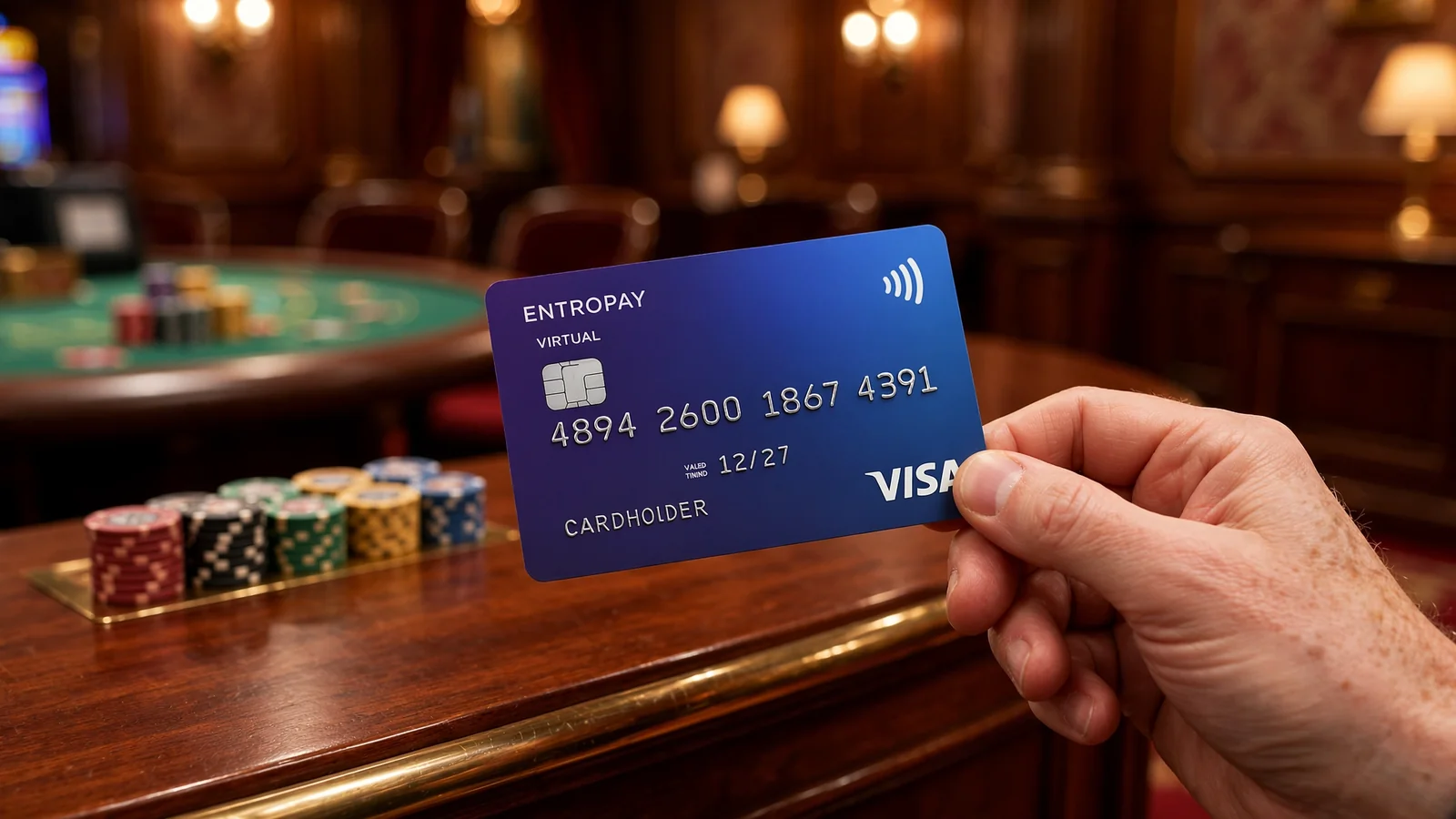
Table of Contents
- How to Check Whether Entropay Is Available at a UK Casino
- A Payment Route Has to Work for Both Deposits and Withdrawals
- When a Payment Method Changes the Bonus Terms
- Other Payment Options Shown in UK Casino Cashiers
- Real-Money Deposits: Check Currency and Total Cost
- What Can Slow a Casino Withdrawal
- Keeping Payment Ownership Details Consistent
- Why the Cheapest Payment Route Depends on the Transaction
- Deposit Limits and the First Funding Decision
- UK Rules That Affect Casino Payment Choices
How to Check Whether Entropay Is Available at a UK Casino
A payment logo on a casino’s information page is a clue, not confirmation that a particular payment product will work. I treat the cashier as the practical test: it shows which methods the operator has made available for the account and transaction in question. A general page may be out of date, cover more than one country or describe a brand without saying which of its card products are eligible.
That distinction matters when checking casinos that accept Entropay in the UK. Entropay may be mentioned in older material or in a broad list of card options, but that alone does not establish that a current UK casino cashier will accept a specific Entropay card. Nor does a Visa or Mastercard logo settle the point. The card network identifies how a card is processed; it does not confirm that the casino supports the particular product, its issuer, or its use for a gambling transaction.
I have seen payment summaries compress several different things into a neat row of logos. The wording can look definite while leaving the operational question unanswered. A specialist review, for instance, may group Visa, Mastercard, bank transfers, e-wallets and cryptocurrencies in its payment overview. That is useful as a broad map of methods discussed, but it is not a live confirmation of what a UK customer can select in a particular cashier.
Casinos That Accept Ethereum in the UK: Payment Checks
Why a general list can mislead
A casino may display a payment brand because some cards on that network are supported. That does not automatically mean every card bearing the logo will pass. The payment route can depend on the card product and the casino’s current arrangements. Availability can also differ between markets, so a method described on a site-wide page may not be available to a UK account.
The reverse can happen too: a cashier may offer a method that is not prominent in a review or general payment guide. These pages serve different purposes. A marketing or help page explains the operator’s broad payment set; the cashier is where an account-level option is presented. Neither should be read as a promise that every card carrying a familiar brand will be accepted.
For Entropay specifically, the useful question is not simply whether a casino lists Visa or Mastercard. It is whether the cashier accepts the particular Entropay-related card product for a UK account at the time of the attempted transaction. A generic network logo does not answer that. Where the cashier gives only a card-brand label and no product-level detail, the eligibility point remains unresolved until the payment route is tested or the operator confirms it.
What to check in the cashier
The check should be made while signed in to the relevant casino account, with the country and account details set correctly. Payment menus can differ by market or account, and a public page may not show those differences. The method should appear as an available choice in the cashier, rather than only in a general list elsewhere on the site.
The label also needs to be read precisely. A cashier showing Visa or Mastercard confirms that the casino presents a card option under that network; it does not, by itself, identify which issuers or card types are eligible. If Entropay is named directly, that is more specific, but the transaction still has to be accepted by the payment process. If it is not named, a network logo should not be treated as equivalent confirmation.
I avoid turning a failed payment attempt into proof that the casino never accepts the product. A declined transaction can have more than one cause, and a generic message may not identify it. Equally, an earlier successful payment or an old review does not prove that the same route remains available now. The relevant evidence is the current cashier and, where its wording is unclear, a direct answer from the operator’s support team about the named card product and UK account eligibility.
Do
- Check the cashier while signed in to your account
- Verify that the country and account details are correct
- Look for the specific product name in the payment menu
Don’t
- Rely on payment logos on general information pages
- Assume a Visa/Mastercard logo confirms product eligibility
- Treat a failed payment as proof that the method is never accepted
That is the difference between a brand being listed and a method being available in practice. A review can help identify what to investigate; it cannot replace the cashier’s current options. No logo shortcut.
A practical way to read the result
The outcome can be recorded in plain terms: Entropay is explicitly named; only a card network is shown; or no relevant card option appears. Those are not interchangeable findings. The first is a direct indication in the cashier, the second leaves product eligibility open, and the third gives no basis to assume the method is available.
For someone comparing online casinos that may take Entropay in the UK, this prevents a common mistake: treating a broad “cards accepted” statement as confirmation about a specific prepaid or virtual card product. A UK-facing site’s payment page can be a starting point, but current UK availability and card-product eligibility need to be checked in that casino’s cashier. The answer belongs to the individual operator, not to the payment logo in isolation.
Our top casino picks for the UK
- DieselwinBonus: Welcome Pack 250% up to £4000 + 200 FS · Payout speed: 1-3 business days
- SpinFormulaBonus: 550% Up To £15,000 + 550 FS · Payout speed: 1-3 business days
- ChanzeBonus: Slots Welcome Bonus #1 200% up to €500 · Payout speed: 1-3 business days
- WinBeastBonus: €5000 + 500 FS + €650 Freebet · Payout speed: 1-3 business days
- EvoSpinBonus: 125% up to €2500 + 125 Free Spins · Payout speed: 1-3 business days
- x3betBonus: Welcome Pack 100% Up to £1.000 + 200 Free Spins · Payout speed: 1-3 business days
A Payment Route Has to Work for Both Deposits and Withdrawals
A payment method appearing in a casino’s deposit cashier answers only one part of the question. It shows that the operator may accept funds through that route; it does not establish that a later payout can be sent back through it. I treat those as separate checks. A route that works in one direction is not automatically a complete way to move money through a casino account.
Casinos that accept iDEAL in the UK: payment checks
That distinction matters when checking an Entropay-related route. A casino may display a payment brand or process a deposit associated with a particular card or account, while its withdrawal rules direct funds elsewhere. The name on a payment list is not a promise about the route a payout will take. The cashier’s deposit screen and the operator’s withdrawal terms need to be read together.
The original source can determine the payout route
UK anti-money laundering rules generally require casino payouts to be returned to the original payment source. This is part of a wider control on how money moves through a gambling account: the operator needs to establish where funds came from and prevent the account from becoming a way to move money between unrelated sources.
In practice, this means that a deposit method cannot be judged only by how easily it funds the account. The casino may expect any eligible return to go back through the source used for the deposit, subject to the payment route being able to receive it. The relevant question is not merely whether a deposit was accepted, but whether the casino’s closed-loop rules allow that same route to be used for a withdrawal.
The phrase “withdrawal supported” can conceal an important distinction. It may refer to a method shown in the payout cashier, or to a route the operator permits for returning funds after a deposit. Those are not necessarily identical. The terms should make clear how the original source is treated and what happens if a return through it is not possible.
UK anti-money laundering rules generally require casino payouts to be returned to the original payment source to prevent accounts from being used to move money between unrelated sources.
Acceptance is not a payout commitment
A successful deposit confirms that a particular transaction was processed. It does not, by itself, settle how a future withdrawal will be handled. The casino may have to apply its source-of-funds controls when a payout is requested, and the answer can depend on the route used to deposit.
I would look for wording that links withdrawals to the original payment source, rather than relying on a general statement that the casino “accepts” a method. That distinction is especially useful when a payment service, card product or account sits behind a familiar brand name. The label may describe the front end of the transaction, while the operator’s records and payment rules determine where a return can be made.
If the original route cannot receive a payout, an alternative may be considered, but it can involve additional verification. That is not the same as having a free choice of destination. The casino may need to establish why the original source is unavailable and confirm the proposed route before releasing funds. A different option may therefore create extra checks rather than simply replacing the first method.
Check the route before relying on it
The practical test is to check the casino’s terms for both sides of the transaction before treating an Entropay-related method as suitable. The deposit information should identify whether the method can be used to fund the account. The withdrawal information should explain whether payouts are returned to that source, whether the route can receive them, and how the operator handles an unavailable original source.
Casinos That Accept Tether in the UK: Payment Guide
If the cashier gives only a broad list of payment brands, that list does not resolve the payout question. The operator’s payment rules are the decisive detail. Where the wording is unclear, a written answer from customer support can clarify how the casino applies its return-to-source policy to the specific route. A general assurance that deposits are accepted is not enough.
This is a matter of transaction structure, not a judgement about whether a method is convenient. A route may be entirely workable for putting money into an account and still be unsuitable if the payout path is unclear or incompatible with the operator’s rules. I would not treat a deposit confirmation as proof that the full payment cycle has been checked.
The safest reading is a narrow one: confirm the deposit route, then confirm the withdrawal route and the original-source rule that connects them. UK anti-money laundering controls make that connection important, while alternatives can bring further verification. The method has to work both ways. Otherwise, the deposit is only half the arrangement.
When a Payment Method Changes the Bonus Terms
A payment method appearing in a casino account does not settle whether a deposit made with it qualifies for a promotion. These are separate decisions: the cashier concerns whether a transaction can be made, while the promotion’s terms determine whether that transaction earns a bonus. I have seen the distinction get missed because the payment logo is easy to spot and the qualifying conditions are tucked into separate wording.
Attention: The presence of a payment method in the cashier does not guarantee bonus eligibility; the specific promotion’s terms must be checked for exclusions.
That distinction matters when considering an Entropay-related deposit at a UK casino. Even if a cashier presents a route that appears relevant, that alone says nothing about bonus eligibility. The offer terms need to identify which deposits qualify and whether any payment methods are excluded. If the wording does not resolve the point, the promotion should not be treated as available on the strength of the cashier display.
The terms are the operative part. Promotional banners are designed to summarise an offer; they are not a substitute for its conditions. A headline may describe a welcome bonus broadly, but a clause can narrow eligibility by payment method. The same applies to a claim that a bonus is available to new customers: it does not, by itself, establish that every deposit route qualifies.
I look for a direct connection between the method and the promotion. The useful wording is not merely that a payment option is accepted, but whether deposits made using it count towards that particular offer. Terms can also state that certain methods are excluded. If a method is named in an exclusion, the general language of the banner does not override it. If the terms are unclear, the bonus position is unclear too.
This is not unique to one payment brand. A specialist review has reported that PayPal can be excluded from bonus eligibility, while specialist reviews have also described Skrill and Neteller as often excluded from promotions. Those are reports about particular terms and changing offers, not a permanent rule for every casino. The operator’s current promotion conditions remain the relevant reference. A method’s reputation or past treatment elsewhere cannot establish the terms of a different offer.
Casinos That Accept Interac in the UK: What to Check
For Entropay, the practical question is therefore not whether another brand has qualified for a bonus, or whether a general payment page mentions payment options. It is whether the specific promotion’s conditions cover the transaction route being considered. If the terms list excluded methods but do not make the status of an Entropay-related route clear, that gap should not be filled by assumption. Acceptance and eligibility remain separate.
I also separate the promotion’s conditions from the value implied by its headline. A bonus may be described as a deposit match or a welcome offer, but the label does not explain which deposits count. The offer’s detailed wording has to be read as a whole: eligibility, any payment-method exclusions and the conditions attached to the promotion all affect what the offer actually means. No single phrase on a banner answers every part.
The cleaner way to assess an offer is to identify the exact promotion first, then check the terms attached to it before treating a deposit as qualifying. A casino can make a payment route available while applying a separate rule to promotional deposits. Conversely, a method’s exclusion from one offer does not establish that it is excluded from every promotion at that casino. Each offer needs its own reading.
That is where promotional language can mislead without being technically false. “Available” may describe the offer to eligible customers, not every customer using every payment method. In my experience, the wording that matters is often less prominent than the headline because it does the limiting work. The distinction is simple. The detail is not.
Bonus Eligibility
- Cashier availability and bonus eligibility are separate decisions
- Promotional banners are summaries and not substitutes for full conditions
- A method’s status in one offer does not determine its status in another
- Terms must explicitly cover the transaction route to confirm a bonus
A bonus should therefore be counted as part of a deposit decision only when the relevant terms clearly support that conclusion. If they do not, the safer interpretation is that eligibility has not been established. This says nothing about whether the casino accepts the method or whether it can be used for withdrawals; those are separate questions. It keeps the bonus decision where it belongs: in the conditions of the specific promotion.
Other Payment Options Shown in UK Casino Cashiers
When Entropay is not displayed as a funding choice, the cashier may still offer other routes. That does not mean there is a universal replacement: payment menus differ between casinos, and a method shown on one site may not appear on another. I treat the cashier as the practical menu, rather than assuming that a method mentioned elsewhere will be available for a particular account.
Debit cards are a familiar option at UK casinos. Visa and Mastercard are among the card brands commonly accepted, but the brand name alone does not confirm that every card product will work. A cashier may identify a card network while the card issuer or the casino’s payment checks determine whether a particular transaction can proceed. The useful distinction is between a payment brand being recognised and the specific route being available.
Bank transfer and open banking are other routes that may appear. A specialist review describes these services as capable of supporting instant deposits and fast withdrawals at many sites; that is not a promise about every casino or every transaction. The labels can also refer to different payment flows. A bank transfer may take place through a bank’s own interface, while an open-banking option can connect the cashier to a bank account for an authorised payment. The actual instructions in the cashier matter more than the broad category name.
Casinos That Accept Giropay in the UK: What’s Verified
Some UKGC-licensed casinos also show Apple Pay for deposits. Its presence is a deposit option, not evidence that every casino supports it or that it can be used for every account. A mobile cashier may make a digital wallet or card-linked option visible, but the device interface does not establish that the casino accepts a particular method. The payment choice still has to be offered by the operator.
Prepaid services can be presented differently from cards and bank-linked payments. Paysafecard, for instance, is a voucher used for deposits only. That distinction is important when comparing the shape of a cashier menu: a method can be useful for adding funds without being a route for taking money back out. Availability should not be confused with a complete payment cycle.
The names and categories on screen can also be narrower than they first appear. A cashier might group several card brands under “cards”, show a bank option under a provider name, or offer only the payment routes its systems can process for that customer. A general payment-method page can describe a casino’s broad capabilities, but it does not substitute for the options presented during an actual transaction.
Debit Cards
Visa and Mastercard are common, but brand recognition does not guarantee every card product will work.
Bank Transfer & Open Banking
Capable of instant deposits and fast withdrawals, with flows varying between bank interfaces and direct connections.
Apple Pay
Available at some UKGC-licensed casinos for deposits, though its presence depends on the operator.
Prepaid Vouchers
Services like Paysafecard are used for deposits only and do not support a complete payment cycle.
I have seen payment menus treated as if they were a fixed feature of a casino. They are better understood as a set of routes the operator makes available in a given context. The visible choices can depend on the account, the payment service and the casino’s own setup. No single list of “best” Entropay casinos can replace that distinction, and an alternative being listed does not establish that Entropay itself is accepted.
For someone looking for Entropay online casinos in the UK, the practical fallback is to compare the options actually displayed rather than infer availability from a brand mention or a mobile-friendly design. A casino may show a debit-card route, a bank-linked option or a deposit-only voucher, while another may present a different mix. Those are alternatives, not proof that a missing payment method can be routed through them.
Different menu. Different route.
Real-Money Deposits: Check Currency and Total Cost
A payment route can look inexpensive until the casino balance and the payment account turn out to use different currencies. Before funding an Entropay-related casino account, the account currency matters as much as the payment label: a deposit processed across currencies can involve conversion, even when the cashier presents the method as available.
A specialist review reports that the relevant casino pages support GBP, but that is not a substitute for checking the currency selected for the individual account. I would confirm it in the account settings or cashier before making the first transaction. A site may display a supported currency on an information page while the account itself is configured differently. That distinction can affect the amount credited and the eventual cost of the deposit.
Casinos That Accept Monzo in the UK: Payment Guide
The sensible comparison is based on the transaction being considered, not on a general claim that one method is “free”. That word can describe only the casino’s side of the payment. A provider, card issuer, bank or payment network may apply its own charge, and currency conversion can add a spread between the exchange rate used and the rate a customer might expect. Which costs apply depends on the route and the currencies involved.
I have seen headline fee comparisons become misleading because they isolate one charge and ignore the rest. A route with no visible casino fee may still cost more overall if conversion is involved; another route may show a charge but avoid that conversion. The useful figure is therefore the total amount leaving the funding source compared with the amount credited to the casino balance. The same route should be assessed against the actual deposit amount, since a fixed charge and a percentage-based cost do not affect every transaction in the same way.
For a UK account, GBP avoids one possible source of conversion cost when the payment also settles in pounds. It does not, by itself, prove that the transaction is fee-free. The provider’s terms and the account currency still matter. Nor does a currency symbol beside a cashier option establish the currency in which the payment instrument will be billed.
Total Cost Factors
Costs can include casino fees, provider charges, card issuer or bank fees, network costs, and currency conversion spreads. The true cost is the difference between the amount leaving the funding source and the amount credited to the balance.
When comparing real-money Entropay casinos in the UK, the practical question is not which label sounds cheapest, but what the complete transaction costs in the account’s chosen currency. I would check the displayed currency, review any charge shown by the casino, then consider provider and conversion costs before confirming. If the final amount is unclear, the advertised fee alone is not enough to make a fair comparison.
Small print matters.
What Can Slow a Casino Withdrawal
A deposit appearing in the casino balance is not a reliable guide to how quickly a withdrawal will reach a bank account. The two transactions travel through different processes. A card deposit can be instant, while a payout may take several business days; that contrast is noted in specialist payment reviews, but the timing of a particular withdrawal depends on the casino and the payment route.
The first stage is often the casino’s own review. A withdrawal request may remain pending while the operator checks the account and approves the payment. That internal handling time comes before any bank or payment network begins delivering the funds. A status marked “pending” therefore does not mean the money is already moving through the banking system.
First withdrawals can take longer when KYC is still being completed. If the casino needs to verify the account before releasing a payout, the review adds a step that may not have applied to an earlier deposit. Specialist reviews describe this as a reason first payouts can take longer. The practical point is that deposit speed says little about whether verification is complete.
Once the casino has approved the withdrawal, the receiving route matters. A bank transfer is not simply a final button press: delivery may be affected by the bank’s processing cut-off, weekends and currency conversion. A request made outside a processing window can wait before it enters the next stage. Specialist payment reviews identify these timing factors, although they do not establish one schedule that applies to every bank or casino.
I would separate the withdrawal timeline into two parts when reading a cashier’s terms: the operator’s processing period and the time after release. They describe different stages, and combining them can make an advertised estimate sound more definite than it is. The casino may control its approval queue; it does not control every step once a payment has been sent onward.
This distinction matters when considering an Entropay-related casino withdrawal in the UK. A fast deposit through a route shown in the cashier would not, by itself, establish how quickly a later payout would be approved or delivered. Nor does it prove that the same route handles both ends of the transaction. Those are separate points to establish before relying on a stated processing estimate.
The useful measure is the complete path: request submitted, casino review completed, payment released, then delivery by the receiving service. A delay at any stage changes the overall wait. Fast in, slower out.
Withdrawal Timeline
Casino Review
The operator checks the account and approves the payment, which may include KYC verification.
Payment Release
The casino sends the funds onward once the internal review is completed.
Route Delivery
Funds move through the bank or network, affected by processing cut-offs, weekends, and conversion.
Keeping Payment Ownership Details Consistent
A payment can be technically available and still encounter a basic ownership check. The casino account and the payment route need to point to the same customer: matching names and account details make that relationship easier to establish. When they do not match, a transaction may need additional checks before it can proceed.
I have seen this treated as a small form-filling issue, but it can become a practical obstacle. A shortened name, a different surname, or payment details belonging to another person can leave the operator unable to connect the funding route with the account holder. That does not, by itself, establish that anything improper has happened. It does mean the casino may have to resolve the mismatch rather than process the transaction routinely.
For anyone considering an Entropay-related route, the relevant point is not just whether a cashier displays a payment brand. The account used for casino activity and the named payment account should belong to the same person, and the details supplied to each should be consistent. A brand listing cannot settle an ownership question.
In my experience, the simplest arrangement is often one named account used consistently for deposits and withdrawals. Keeping the same account holder details across the casino profile and payment route reduces avoidable back-and-forth and makes the transaction trail easier to understand. Switching between accounts or using someone else’s payment details adds complexity without improving that clarity.
This is separate from the casino’s rules about where funds are sent after play. The point here is ownership: the operator needs a clear link between the customer and the payment account. Consistency helps. Mismatched details invite questions.
Casinos That Accept Maestro in the UK: What to Check
Why the Cheapest Payment Route Depends on the Transaction
A payment route has no fixed price in isolation. Its cost can be split across the casino, the payment provider, the card issuer or bank, and, where relevant, the network handling the transaction. A cashier may show no casino fee while another party applies a charge. The visible price is not always the whole price.
In a specialist review, payment costs are described as potentially including provider fees, bank or issuer charges, casino fees, network costs and currency conversion. That is a useful checklist, not a promise that every charge applies to every transaction. The terms for the chosen route and the account statement show where a cost may arise.
Currency conversion deserves separate attention. A transaction can carry no obvious flat fee and still cost more through the exchange rate offered by a provider or network. The gap between that rate and the rate used for comparison is the conversion spread. It can outweigh a clearly stated charge, so looking only for a line labelled “fee” gives an incomplete result.
The total also depends on the amount and direction of the transaction. A charge that matters little on one transfer may take a larger share of another; a cost applied by a bank or provider may sit outside the casino’s own terms. For an Entropay-related route, the name alone cannot establish what the complete charge will be. The relevant terms are those attached to the actual payment product and transaction.
Credit Card Ban
Credit-card payments for gambling are prohibited in the UK. This includes using wallets that allow credit-card funds to be used for gambling.
I have seen payment comparisons made from a single headline figure. That misses the mechanics. Compare the amount leaving the payment account with the amount credited, and account for any later conversion or separate charge shown by the provider, bank or casino. No universal cheapest route.
Deposit Limits and the First Funding Decision
The amount a cashier allows is not a single figure attached to a casino. A minimum can differ between payment methods, and the maximum may be set per transaction, across a day or over a month. Account status can also affect the ceiling. A specialist review may describe a minimum in the £10–£20 range, but that should be treated as a reported snapshot, not a promise that the same threshold applies to every route or account.
For a deposit linked to an Entropay-related route, the relevant figures are the ones displayed for that transaction in the casino cashier. A method’s presence elsewhere on a site does not establish the minimum or maximum available to a particular customer. Limits can be applied at several levels, so a transaction cap is not necessarily the same as an account’s daily or monthly allowance. Check the displayed amount before submitting; an attempted deposit outside the permitted range may simply fail.
There is a separate decision before funding begins. UKGC-licensed remote gambling operators must ask new customers to set a financial limit before the first deposit, and provide account controls for setting or changing limits. That is an account-level safeguard, not a payment-method cap. The cashier may show how much a route can process, while the account limit determines how much the customer has chosen to make available for gambling.
I have seen those two controls treated as if they were interchangeable. They are not. A high transaction ceiling does not override a personal account limit, and setting a personal limit does not change the payment method’s own thresholds. The first deposit sits behind both checks. Keep the distinction clear.
Casinos That Accept AstroPay in the UK: What to Check
UK Rules That Affect Casino Payment Choices
The UK boundary is about the source of funds, not simply the name displayed on a payment button. Credit-card payments for gambling have been prohibited since 14 April 2020, and the rule has not been relaxed. A UK-licensed casino cannot accept a credit card as the means of funding a gambling account.
The restriction also covers an indirect route. A wallet cannot be used for gambling payments where it allows credit-card funds to be used for gambling. Adding a wallet between a card and a casino does not make a prohibited credit-funded payment acceptable. In practice, the relevant question is how the wallet is funded and whether that funding can be used for gambling—not just whether the cashier lists the wallet.
That distinction matters when assessing an Entropay-related payment route. A familiar product name does not override the UK rule, and its appearance in a payment list would not establish that every card or wallet connected with it is eligible. The transaction still has to comply with the restriction on credit-card funding. No workaround.
From the operator’s side, payment controls have to account for how funds enter the gambling account, including when a payment service sits between the customer and the casino. That is why a route that looks like an ordinary wallet payment may still be unavailable for gambling if credit-card funds can pass through it. The rule is not limited to a card number entered directly into the casino cashier.
I treat the date as a fixed regulatory boundary, not a temporary cashier setting: the ban began on 14 April 2020 and remains in force. It applies to credit-card payments for gambling at UK-licensed casinos, including prohibited credit-funded wallet payments. The payment label alone is not decisive.
Why must withdrawals return to the deposit method?
UK anti-money-laundering and anti-fraud controls commonly require withdrawals to go back to the original payment source. An alternative route may require additional verification.
What is the fastest withdrawal method for UK casinos?
PayPal, open banking services and debit cards linked to fast payout systems are generally among the quickest. The casino’s approval process and whether your account is verified also affect how long a withdrawal takes.
Is Skrill available?
Yes, Skrill is available at some UK-friendly casino sites. Its availability and bonus eligibility can vary by casino.
Can I deposit in GBP?
Yes, GBP is supported. Check the account currency before your first transaction to avoid conversion.
What is the current minimum deposit?
The minimum deposit usually starts at £10–£20, depending on the payment method.
Are Visa and Mastercard deposits definitely debit cards?
No. Visa and Mastercard logos show the card network, not whether a particular card product is eligible; check the casino cashier for the available options.
Written by the editors at Grovers Casino.